news
维替流体控制有限公司 2026-06-08 16:41 9675
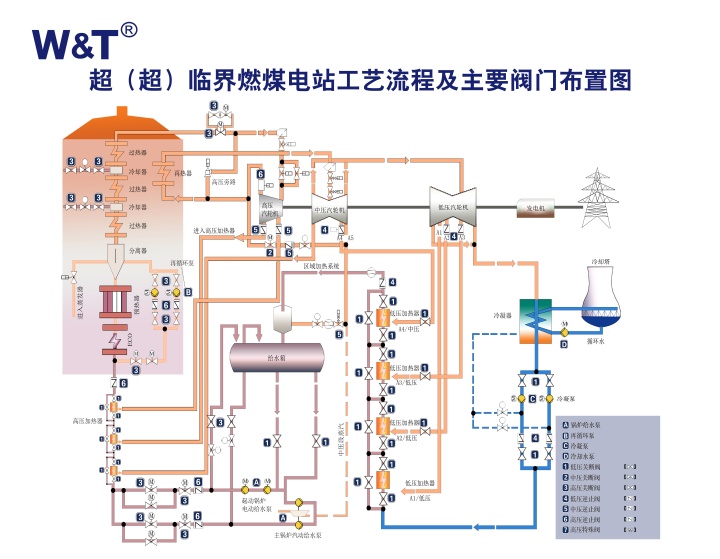
In the thermal system of a thermal power plant, the boiler side is one of the areas with the most stringent operating parameters and the most concentrated safety risks. Here, a large amount of high-temperature, high-pressure and high-flow-rate steam and feed water media are accumulated. The valves not only have to withstand long-term continuous impact and erosion, but also need to deal with complex working conditions such as frequent regulation, shut-off and drainage. Therefore, the stability and reliability of the valves on the boiler side directly affect the operational efficiency and maintenance cycle of the unit. In recent years, with the increasing requirements for energy conservation, consumption reduction and intelligent operation and maintenance in thermal power plants, the transformation of boiler-side valves has become an important entry point for the comprehensive upgrading of units.
W&T Fluid Control, with its profound technical accumulation in areas such as high pressure difference, two-phase flow, and high-temperature working conditions, has developed a full-chain upgrade solution covering regular blowdown, continuous blowdown, and desuperheating water systems, focusing on key workstations on the boiler side. The following are the main technical paths and mature application descriptions:
1. Regular drainage and continuous drainage systems
During the operation of the boiler, the continuously concentrated impurities, salts and suspended solids in the water need to be promptly discharged through the blowdown system to prevent the deterioration of boiler water quality, the risk of pipe scaling or pipe burst. Among them:
Regular blowdown (fixed blowdown) : It is usually placed at the lowest point of the boiler water circulation system (such as the bottom of the downcomer or header), used to quickly discharge the sludge and high-concentration impurities formed by sedimentation. During operation, the valve opening time is short but the pressure difference is extremely large. The internal fluid expands rapidly from a high-temperature and high-pressure state in an instant, which can easily cause flash evaporation and cavitation.
Continuous blowdown (continuous discharge) : Continuously discharge high-concentration suspended impurities and dissolved solids from the surface of the boiler water to maintain a stable salt content in the boiler water. Under this working condition, the flow rate is relatively continuous, and the valve needs to operate for a long time in a state of high pressure difference and low opening regulation.
Whether it is a fixed row or a continuous row, the common technical difficulties of the valves lie in: gas-liquid two-phase flow, high-flow scouring, severe flash vapor erosion, and short service life of the sealing surface. For ordinary structure stop valves or gate valves, problems such as pitting on the sealing surface, perforation of the valve core, and erosion of the valve seat often occur within a few maintenance cycles, which leads to intensified internal leakage, increased system energy consumption, and even affects the safety of the boiler.
Viti Solution: Labyrinth Sleeve Multi-stage pressure Reducing Drain valve
In response to the above pain points, Viti recommends the use of labyrinth sleeve structure multi-stage pressure-reducing blowdown valves in fixed and continuous discharge systems. Its core technical features include:
Multi-level pressure reduction and step-by-step speed control
A specially designed labyrinth sleeve is set inside the valve, which gradually disperses the one-time high pressure difference before and after the valve through multiple independent tortuous flow channels. The pressure drop at each stage is controlled above the saturated vapor pressure of the medium, effectively suppressing the intense occurrence of cavitation and flash evaporation, and protecting the valve core and valve seat from premature damage.
Anti-cavitation and anti-erosion structural design
By optimizing the flow channel direction and throttling area, the fluid is made to collide with the labyrinth groove wall at high speed and continuously rotate, consuming energy while reducing the outlet flow velocity, significantly alleviating the mechanical erosion on the metal substrate. This structure is particularly suitable for harsh sewage discharge media containing solid particles and mixed bubbles.
High-hardness sealing surface material
The sealing surfaces of the valve core and valve seat are both surfacing with cobalt-based hard alloys (such as Stellite), which have excellent high-temperature red hardness, wear resistance and corrosion resistance, and can maintain high hardness and scratch resistance at temperatures above 600℃. Even under high-frequency blowdown or low-opening throttling conditions, it can maintain reliable sealing for a long time.
Online maintainable and with a long service life
The labyrinth sleeves and valve internals mostly adopt modular design, which is convenient for replacing vulnerable parts during maintenance. Meanwhile, as the fluid energy is fully controlled, the wear rate of the valve internals significantly decreases, and the overall service life can be increased by 2 to 3 times compared with the traditional structure.
Application effect: After adopting the Viti labyrinth blowdown valve, the fixed and continuous blowdown systems of power plant boilers can significantly reduce the problem of valve internal leakage, extend the A/ B-level maintenance interval, lower the loss of working medium and heat energy, and at the same time enhance the operational safety of the drainage system. In combination with a reasonable sewage control strategy, the quality of the boiler water can be further improved, the loss of steam and water can be reduced, and the goal of energy conservation and consumption reduction on the boiler side can be achieved.
Demand feedback
Vite Control Fluid GMBH in Germany specializes in manufacturing a full range of valve products, including automatic control regulating valves, which are applied in harsh working conditions such as high temperature, high pressure, easy erosion and corrosion. Vite Control Fluid GMBH in Germany has highly specialized engineering personnel and production equipment, and collaborates with renowned domestic universities and professional institutions in the fields of material development, fluid mechanics, valve system design and production.