
news
维替流体控制有限公司 2026-06-25 15:35 13916
In thermal power plants, the problem of ash accumulation on the heating surfaces of boilers is an important factor affecting thermal efficiency and safe operation. As the main means of ash cleaning, the core equipment of the steam soot blowing system - the steam soot blowing regulating valve - is constantly under the harsh working conditions of high-frequency opening and closing, high temperature and high pressure, making it a "disaster area" for valve failures in power plants.
I. The "Survival Dilemma" of Ash Blowing Control Valves: Why Are They prone to Problems?

The working principle of the steam soot blowing system is to send high-temperature and high-pressure steam into the soot blower through the regulating valve to periodically blow the heating surface of the boiler. This seemingly simple process places extremely high demands on the control valve:
High-frequency opening and closing, large fatigue load: The soot blower operates periodically, and the regulating valve frequently opens and closes. According to some data, the average service life of lift valves in some high-frequency usage areas is even no more than half a year, which is difficult to support a major overhaul cycle.
High temperature and high pressure make materials prone to degradation: Repeated erosion by high-temperature steam can easily cause thermal fatigue cracks in the valve body. A certain supercritical boiler once had its valve seat cracked due to the low material selection of the ash-blowing regulating valve body and long-term alternating cold and hot operation.
Erosion and cavitation, sealing surface damage: Under high pressure difference, steam flows at high speed, which is very likely to cause erosion and cavitation damage. Once the sealing surface is damaged, it will cause internal leakage of the valve, resulting in steam waste, reduced soot blowing effect, and even affecting the safety of the boiler.
Ii. Facing Challenges Head-on: Systematic Improvement from Materials to Structure
In response to the "pain points" of soot blowing control valves, mature solutions in the industry focus on material strengthening and structural optimization:
Hard alloy surfacing - Putting on "armor" for the sealing surface. The sealing surface is the first line of defense for the control valve to resist the scouring of high-speed steam. The surfacing process of hard alloys (such as cobalt-based alloys) can significantly enhance the hardness and wear resistance of the sealing surface, which is a key technology for extending the service life of valves. This treatment method can effectively counteract the erosion of impurity particles in steam and reduce internal leakage caused by damage to the sealing surface.
2. The reasonable structure design of the valve internals with scouring resistance and throttling can guide the medium to flow in an orderly manner and reduce the direct impact of turbulence on the valve internals. By adopting structural designs such as multi-stage throttling and pressure reduction, the high pressure difference can be decomposed into multi-stage stepwise pressure reduction, significantly reducing the erosion damage of the fluid to the sealing surface, while also alleviating vibration and noise.
3. Overall performance Improvement: Besides sealing and flow channels, the overall performance of the valve also needs to be optimized. This includes the adoption of more compatible valve body materials (such as heat-resistant steels like 12Cr1MoV) to adapt to high-temperature working conditions; Improve the valve core structure (such as pre-lift valve cores) to achieve a tight cut-off and eliminate dead zones; And it is equipped with a stable and reliable double-acting actuator to ensure the regulation accuracy under high-frequency actions.
Iii. Vitite Solution: Safeguarding Every Soot Blowing with Technological Strength
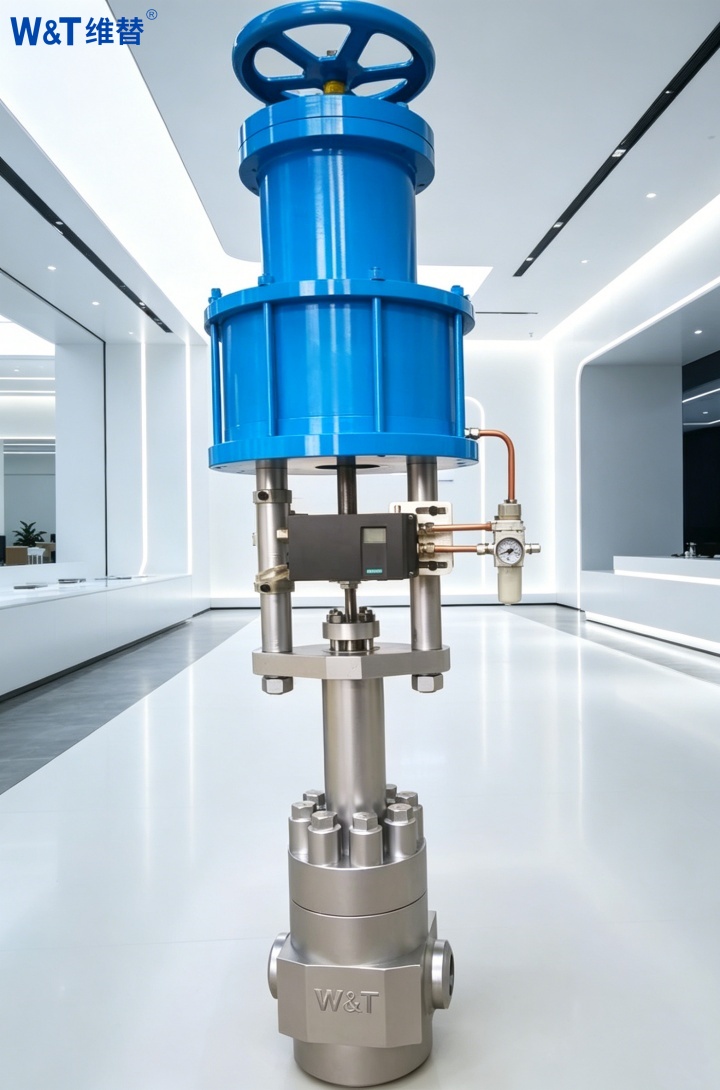
Facing the severe challenges of the soot blowing control valve, Viti Fluid Control has proposed a targeted solution: adopting a hard alloy surfacing sealing surface and an erosion-resistant flow channel design.
Hard alloy surfacing sealing surface: Key sealing parts such as the valve core and valve seat adopt cobalt-based hard alloy surfacing technology, which maintains high hardness and excellent wear resistance and erosion resistance at high temperatures, fundamentally enhancing the "impact resistance" of the sealing surface.
Erosion-resistant flow channel design: By integrating multi-stage pressure reduction, streamlined flow channel and other design concepts, the medium flow path is optimized, effectively reducing the direct erosion of high-speed steam on the valve internals and extending the service life of the valve. Through this solution, Viti is committed to helping power plants solve the long-standing problems such as high-frequency internal leakage, jamming, and poor linear regulation of ash blowing regulating valves, ensuring the safe and reliable operation of the ash blowing system and reducing maintenance costs.
Viti - an expert in providing comprehensive solutions for pipeline fluid problems, offers reliable valve products and services to key workstations in power plants.
Demand feedback
Vite Control Fluid GMBH in Germany specializes in manufacturing a full range of valve products, including automatic control regulating valves, which are applied in harsh working conditions such as high temperature, high pressure, easy erosion and corrosion. Vite Control Fluid GMBH in Germany has highly specialized engineering personnel and production equipment, and collaborates with renowned domestic universities and professional institutions in the fields of material development, fluid mechanics, valve system design and production.